
Toronto draws you in not just with its towering skyscrapers and the vastness of Lake Ontario, but also with its rich symbolism. These symbols reflect the city’s history, diverse cultures, and big ambitions. From its civic emblem and flag to its official coat of arms and even street art, these aren’t just pretty decorations; they’re important carriers of meaning. Each one holds a piece of Toronto’s character: from a drive for openness and change to a deep respect for history and the communities that built it. In this article, we’ll dive into Toronto’s main symbols, how they came to be, why they matter, and how they help tell the story of one of Canada’s most multicultural cities. Dive deeper with itoronto.
Toronto’s Coat of Arms and Motto
In 1997-1998, when Toronto officially became a “megacity” through the amalgamation of six municipalities and the metropolitan area on January 1, 1998, the process of creating a new coat of arms began. The Canadian Heraldic Authority took on the task, specifically Chief Herald of Canada Robert Watt and his team of experts. Before they started designing, a public survey was conducted, with about 1,100 residents sharing their ideas for symbols. This input meant the final design included elements from the former municipalities, along with natural and cultural symbols. After getting the city council’s approval, the design was officially adopted on January 11, 1999, and publicly unveiled through Letters Patent on July 22, 2000.

To be honest, few people walking through downtown Toronto really notice the city’s coat of arms. But that’s a real shame, because its imagery tells a whole story about how one of Canada’s biggest cities took shape. To truly grasp Toronto’s character, you just need to look closely at the details. At the very centre of the coat of arms is a shield divided into four sections. Each part pays tribute to a distinct area that was once its own city: York, Etobicoke, Scarborough, and North York. Toronto emerged because these municipalities merged in 1998, and the coat of arms still honours that historic moment. In the upper part of the shield, you’ll spot the silhouette of City Hall—its curved towers are instantly recognizable to anyone who’s ever visited Nathan Phillips Square. This isn’t just an architectural detail; it’s a symbol of modern Toronto, which is looking more and more like a world-class metropolis every year.
Above the shield, you’ll find a beaver and a bear – classic Canadian wildlife. They weren’t chosen by chance: the beaver symbolizes hard work, while the bear stands for strength and endurance. These are qualities the city doesn’t just respect, but actually relies on. And the motto below the coat of arms really deserves special attention. Etched in Latin, it reads Diversity Our Strength. Even though this phrase appeared with the new Toronto, its meaning couldn’t be more accurate. A city where hundreds of nationalities, languages, and cultures live side by side has long made diversity its hallmark. Here, it’s not just words; it’s a way of life.
So, Toronto’s coat of arms isn’t just some abstract picture for official papers. It’s a miniature story about the city: its past, its character, its ambitions, and most importantly, the people who built it. Next time you see it on a building or in an official brochure, don’t just walk by—there’s more to it than meets the eye.
The Flag with the City Hall Silhouette
Picture a city flag. Not a national or provincial one, but a municipal flag that doesn’t just wave in the air, it tells a story. Toronto has just such a flag, and it’s nothing like your typical collection of crests and stripes. It features architecture, nature, and a dash of patriotism. It’s that familiar blue flag with a white “T” shape that also resembles City Hall’s facade, with a vibrant red maple leaf in its centre. This design wasn’t handed down “from above” or bought from a consulting agency. It was created by local designer Renato De Santis back in 1974. There was an open competition, and he was the winner. It’s quite straightforward: the “T” stands for the first letter of the city’s name, while also looking like City Hall’s two towers with the inner courtyard between them. At the heart of that space is the Canadian maple leaf, symbolizing Toronto’s place within Canada and adding a bright pop of colour.

The flag is highly recognizable, even if it’s not always widely displayed around the city. You can spot it near City Hall, on municipal buildings, and during official events. While residents might not always give it much thought, it perfectly combines modern architecture, national identity, and simple graphics that hold it all together.
The Toronto Sign – An Icon of the Urban Landscape
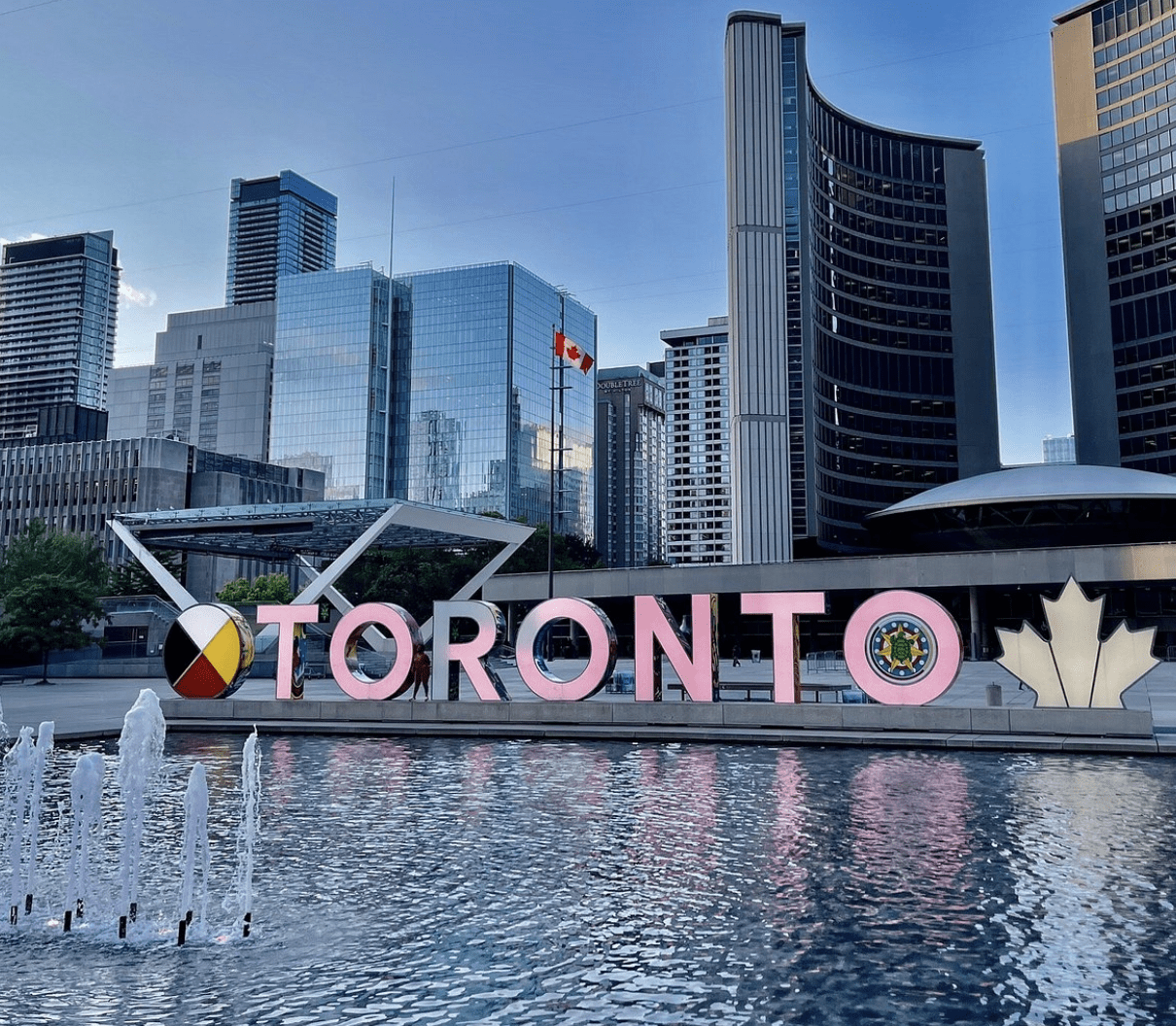
Right in the heart of Toronto, in front of City Hall at Nathan Phillips Square, stands the massive word “TORONTO.” These white, three-dimensional letters, almost two metres tall, glow in various colours at night, shimmer in the sun by day, and always draw attention. If you’ve never been to the city, you might not have realized that this installation has become one of Toronto’s most recognizable spots. For locals, it’s more than just a sign—it’s part of the cityscape, a place for meetups, photos, walks, and even protests.

This sign popped up quite recently, in 2015, just before the Pan American Games were held in the city. Back then, no one planned to keep it for long; it was meant to be a temporary art piece for tourists. But things didn’t go as planned: Torontonians and visitors fell so in love with the sign that it stayed even after the games. And it didn’t just stay; it became a permanent fixture of the urban environment. It’s been updated and repaired multiple times, with new symbols added, like a maple leaf or the traditional Inuit stone landmark, the inukshuk.
The Toronto Sign is hard to compare to traditional monuments, as it lacks bronze, granite, or nameplates. But it achieves something that even the most famous statues sometimes can’t: it creates an atmosphere of openness, modernity, and a lively urban beat. And even though it might seem like just letters, through them, Toronto says “Welcome” to everyone who visits and reminds locals: this is your city, alive, vibrant, and a little bit quirky.
The Oak – Toronto’s New Green Symbol
Not all city symbols have to be monuments or buildings, right? Sometimes, something simple, like a tree, is enough. That’s exactly what happened in Toronto when the oak was declared the city’s official tree in 2022. You might think, “What’s so special about an oak?” It grows in parks and forests, sways in the wind, and its golden leaves bring joy in the fall. But there’s much more to this decision than meets the eye. The oak in Toronto symbolizes stability, resilience, and deep roots—quite literally. You can find it in many parts of the city, especially in natural areas that still remember a time before heavy development. And what’s most interesting: the oak is one of the most common native trees here; it grew long before the first stone streets appeared.

When the city was looking for a symbol to highlight its natural heritage, environmental responsibility, and love for green spaces, this natural creation was the clear choice. It managed to combine several values at once—history, strength, beauty, and ecological significance. Plus, the oak is about connecting with local communities, especially Indigenous peoples, for whom this tree holds special spiritual meaning. And while it doesn’t light up at night like the Toronto Sign or reach for the sky like the CN Tower, it has still become another marker of what Toronto residents want their modern city to be.